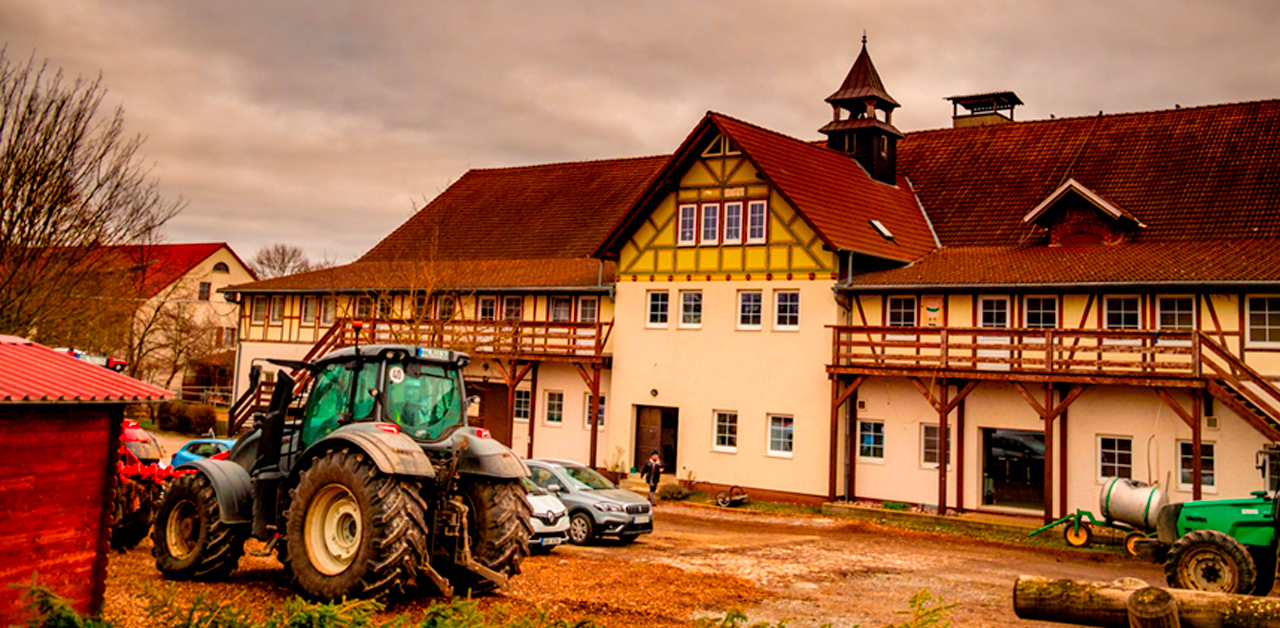
GUT SAMBACH
IDENTIFICATION OF THE CASE STUDY
Case study number: DE-05
Name of the farm/organization: Gut Sambach / Sambach Grange
Title of the case study:
Biodynamic mixed farm with psychiatric patients
MAIN DATA
Country
Germany
Year of establishment
2007
Target groups
- Disabled people
Type of farm
Biodynamic mixed farm (Demeter) (dairy cows, pigs, vegetables, grain)
Size (in hectares)
520 ha (150 ha pasture and 370 ha arable land)
Numbers of employees from target groups
30-35 clients
Number of members from target groups using services without employment
6-7
Sources they live from
Own products, funding, care allowances
Innovative / not innovative
Innovative
Websites
www.8dc6460bbbb088757ed67ed8fb316b1b-gdprlock/gutsambach/
DESCRIPTION
Gut Sambach is a farm where learning disabled people work and which has become a recognized workplace for this target group in 2007. The farm is located close to Mühlhausen/Thuringia (Germany). The farm includes 520ha which are managed biodynamically since 1997. On the farm they have a butchery, a bakery, a cheese dairy, a biogas plant and they hold pigs and dairy cows. People with learning disabilities live in halls of residence on the estate. They work within all branches of industry on the farm. Altogether a number of 35 people with learning difficulties and mainly psychiatric problems live and work there. The concept of the estate is to create a place where people with special needs can work. Because for them it is important to include people with special needs into society. The therapy they work with is that people with learning disabilities mainly live and work on the farm together with trained specialists and so they get the chance to do meaningful work. Financially the income is divided into four different parts. 15-20% of the incomes comes through care allowance for people with special needs, 25% of the income come through the economic part of the farm like producing biogas, 25% of the income the farm get through incentives from the government and the last 25% they get through selling their products like cheese, vegetables or meat.
POSITIVE PERSONAL EXPERIENCE
In the past Gut Sambach has been managed conventionally. When Dr. Friedhelm Feindt took on the farm he converted the management from conventional to biodynamic farming. Furthermore he established processing like an own butchery on the farm as well as a bakery and a farm shop; furthermore mobile sales vehicles that sell products at several markets. “This farm has been a life-long project for me that always deserves improvement”. Being asked for the biggest successes within the last few years, Friedhelm Feindt says that the farm got acknowledged by politics as an exciting showcase for social farming. Moreover the just won an important prize for the bread they produce in their own bakery.
OBSTACLES AND HOW TO OVERCOME
In general one of the biggest obstacles they have to face is that the bureaucratic effort to maintain the different branches of industry has increased over the years. Friedhelm Feidt thinks that one reason for this problem is that people who work in public office nowadays are disconnected from practical agriculture. So they implement new laws and regulations without knowing whether it is going to work in reality. “And the ability to work decreases” compared to the clients only few years ago. Friedhelm Feidt thinks that one of the reason for that are mobile phones. Clients are easily distracted by them and it is harder for them to concentrate on their work. The economic benefit for the farm by integrating clients is not as high as it could be, he says. One way to try to overcome the problem clients have by using their smartphones is that he tries to convince them to use key mobile phone. “Because clients are not as much distracted by those type of phones”, he says.
RECOMMENDATIONS, ADVICE
Friedhelm Feidt would like to give the advice to conventional farmers to observe more what their soil does and how it changes over seasons. So that they can improve their perception and attitude about how to work with their land. The other advice he gives to farmers who would like to start social farming is that they should take advantage of advice before doing that. Professional advice and coaching is needed after collecting all relevant information to decide whether to start and develop social farming on your farm. “The farmer should not offer the inclusion of people with handicaps for free because it is always a bit of extra work to have someone with special needs working on the farm. Each federal state has different possibilities to offer a budget for working with people with special needs. But you really need to be well informed about the possibilities in order to get that financial support.”
PROMO
The main farm sales Gut Sambach gets through direct marketing. All their products from the cheese dairy, the bakery, the market garden and their butchery are directly sold through their farm shop or on farmers markets. Gut Sambach is promoted through a facebook page where they do weekly posts. Once a years a Christmas market takes place on the farm with is well visited every year.
FINAL SENTENCES
Being asked for future perspectives, with a smile Friedhelm Feindt expresses his hope “that the University Kassel-Witzenhausen will introduce obligatory internships for their agricultural student on farm in the former East Germany.” He himself plans for the coming five years to retire and to find a successor to take over his role of managing the estalte. He is especially proud about the fact that Gut Sambach has been able to exist until now and that such a great farm is located in Mühlhausen.

 EN
EN
 CS
CS
 DE
DE
 IT
IT
 PL
PL
 SK
SK